Zehanpora Stupas Kashmir Ias Banenge
Why in News?
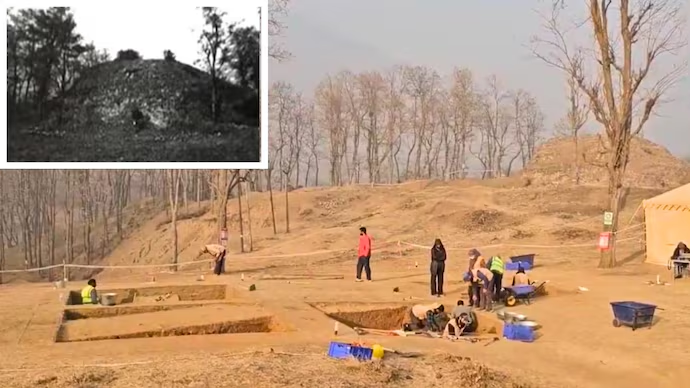
- Archaeological discovery of ancient Buddhist stupas at Zehanpora, Baramulla (J&K).
- Site mentioned by Prime Minister in Mann Ki Baat.
- Excavations suggest structures dating back to the Kushan period (≈2,000+ years old).
- Reinforces Kashmir’s overlooked Buddhist heritage.
Relevance
GS I – Art & Culture / History
- Buddhism in India.
- Kushan period.
- Stupa architecture.
GS I – Indian Society
- Cultural pluralism.
- Historical continuity in Kashmir.
Basics: What are Stupas?
- Stupa:
- Buddhist commemorative structure.
- Houses relics of the Buddha or monks.
- Core elements:
- Anda (hemispherical mound)
- Harmika
- Chhatra
- Functions:
- Religious worship.
- Symbol of Buddha’s enlightenment and Mahaparinirvana.
Location & Site Details
- Zehanpora village, near Baramulla town, north Kashmir.
- Spread across 10+ acres.
- Landscape:
- Plateau-like mound.
- Reduced over centuries due to:
- Floods.
- Canal digging (1970s).
- Long mistaken as natural earth mounds.
Archaeological Findings
- Multiple earthen mounds forming a stupa complex.
- Evidence suggests:
- Wooden superstructure over stone base.
- Site used as winter halt for monks.
- Methods used:
- Modern archaeological tools.
- Drones and remote sensing.
Dating & Historical Context
- Estimated age: ~2,000 years.
- Period:
- Kushan Empire (1st–3rd century CE).
- Kushans known for:
- Patronage of Buddhism.
- Trade along Silk Route.
- Gandhara art tradition.
Buddhism in Kashmir: Historical Background
- Introduced during:
- Mauryan period (Ashoka) — traditional belief.
- Major expansion under:
- Kanishka (Kushan ruler).
- Kashmir’s role:
- Scholarly centre of Buddhism.
- Transmission point to Central Asia and China.
- Buddhist councils:
- 4th Buddhist Council traditionally associated with Kashmir (per some sources).
Why Zehanpora is Significant ?
- Adds to known Buddhist sites:
- Harwan
- Kanispora
- Ushkur
- Hutmur
- Semthan
- Confirms:
- Dense Buddhist settlement in north Kashmir.
- Shows:
- Kashmir as a monastic and trade hub, not peripheral region.
Global Link: France Connection
- Photograph of Zehanpora site found in French museum archives.
- Indicates:
- Colonial-era documentation.
- Early European scholarly interest.
- Reflects:
- Global dispersal of Indian archaeological records.
Cultural & Civilisational Significance
- Challenges narrative of Kashmir as only:
- Shaivite or Islamic heritage region.
- Highlights:
- Pluralistic religious history.
- Cultural continuity across centuries.
- Strengthens:
- Buddhist civilisational map of India.
Governance & Heritage Implications
- Need for:
- Site protection.
- Scientific excavation.
- Heritage tourism integration.
- Aligns with:
- Cultural revival initiatives.
- Soft power diplomacy via Buddhism.
Takeaway
- The Zehanpora stupa complex reaffirms Kashmir’s role as a major Buddhist centre during the Kushan period, highlighting the region’s deep civilisational pluralism and strategic position in ancient trans-Asian networks.