HPV Vaccine & Herd Protection Ias Banenge
Why in News?
- A large Swedish population-based study shows school-based HPV vaccination provides herd protection, reducing cervical cancer even among unvaccinated women.
- Evidence strengthens the case for including HPV vaccine in India’s Universal Immunisation Programme (UIP).
- Relevant as India is planning school-based HPV vaccination (ages 9–14).
Relevance
GS II – Governance & Social Justice
- Public health policy.
- Universal Immunisation Programme.
- Women’s health.
GS III – Science & Technology / Health
- Preventive healthcare.
- Vaccine science.
- Disease elimination strategies.
Basics: What is HPV?
- Human Papillomavirus (HPV):
- Sexually transmitted virus.
- >200 types identified.
- High-risk strains (notably HPV-16, HPV-18) cause:
- ~95% of cervical cancer.
- Also linked to:
- Anal, oropharyngeal, penile cancers.
- Genital warts (low-risk strains).
Cervical Cancer: India Burden
- 2nd most common cancer among Indian women.
- Annual impact:
- ~1.25 lakh new cases
- ~75,000 deaths
- Disproportionately affects:
- Low-income, low-screening populations.
What is Herd Protection?
- When high vaccination coverage reduces overall virus circulation.
- Protects:
- Unvaccinated individuals.
- Especially relevant for sexually transmitted infections when transmission chains are disrupted.
Key Findings of the Swedish Study
- Cohort:
- Women born 1989–2000.
- Vaccination coverage:
- Rose from 25% → 80% via school-based programmes.
- Results:
- Significant reduction in precancerous cervical lesions.
- Even unvaccinated women benefited if community coverage was high.
- Critical thresholds:
- ≥70% coverage → visible herd effects.
- ~90% coverage → optimal protection.
Why School-Based Vaccination Works ?
- Early age (9–14):
- Vaccination before sexual debut → maximum efficacy.
- School-based delivery:
- Higher coverage.
- Lower dropout.
- Equity across socio-economic groups.
- Cost-effective at population scale.
HPV Vaccine: Scientific & Medical Aspects
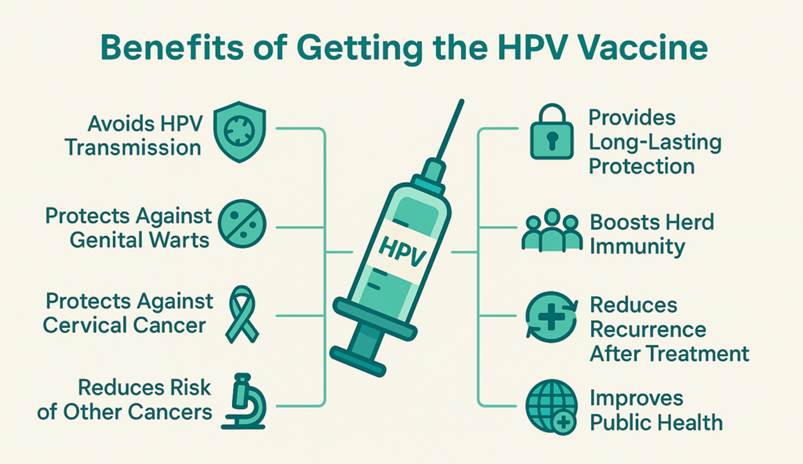
- Type: Preventive, not therapeutic.
- Effectiveness:
- Nearly 100% protection against HPV-16/18-related precancerous lesions.
- Limitation:
- Does not eliminate need for screening (Pap smear / HPV DNA test).
- No proven herd immunity evidence yet in India, but established in:
- Sweden
- UK
- Australia.
India’s Current Position
- Indigenous vaccine:
- CERVAVAC developed by Serum Institute of India.
- Policy direction:
- Govt considering routine immunisation inclusion.
- Proposed age group: 9–14 years.
- Challenges:
- Awareness gaps.
- Vaccine hesitancy.
- Need for adolescent health infrastructure.
Public Health Significance
- Shifts cervical cancer control from:
- Late-stage treatment → Primary prevention.
- Reduces:
- Screening burden.
- Long-term oncology costs.
- Aligns with:
- WHO Cervical Cancer Elimination Strategy:
- 90% vaccination
- 70% screening
- 90% treatment.
- WHO Cervical Cancer Elimination Strategy:
Ethical & Social Dimensions
- Gender equity:
- Protects women disproportionately affected.
- Intergenerational benefit:
- Herd protection amplifies social returns.
- Justice argument:
- Preventable cancer → moral obligation of the State.
Takeaway
- High-coverage, school-based HPV vaccination can generate herd protection, making cervical cancer a largely preventable disease and strengthening the case for its inclusion in India’s universal immunisation strategy.